
Paru Amma sat still, forgetting her surroundings, not even noticing that the rice had boiled over and extinguished the hearth. On her right side hung a large coconut-palm fronds-mat. She had to barely turn her head; through a gaping hole in the mat, everything next door could be seen. The other side of the road was elevated. The number of rooms in that house, the exact spot where the kitchen stood, the bathroom – Paru Amma knew it all. Her memories would fly back to her maidenhood when someone came occasionally to stay there. Once she reached that time, her mind would dwell upon the house and it alone. Continue reading “The Woman Subordinate: K Saraswathi Amma”
Fiction
Bookish Love: K Saraswathi Amma
Passing the Bachelor’s degree in English with first-class marks from the college in Changanasherry landed me in a proper soup. My extreme commitment to textbooks granted me the ability to swallow all of it by heart, and this dragged towards me the Goddess of Victory and Prosperity, who however indulged in pranks worthy of a total imp. Thus I set out to study for an MA degree in English in the capital city with my father’s help and the blessings of the Catholic priests who had taught me. Continue reading “Bookish Love: K Saraswathi Amma”
Fifty-five Passengers Only: K Saraswathi Amma
The conductor managed to free one hand and blow the whistle. The bus began to move. Many who had earlier advanced rightful claims were now reduced to begging. There were folks who had to reach weddings before the auspicious hour; also people whose very families were in danger of being thrown out bag and baggage if they didn’t reach the court on time and win the case. Continue reading “Fifty-five Passengers Only: K Saraswathi Amma”
In Defiance of Living Death: The Life and Struggles of K Saraswathi Amma – 2
Finally, the common rejection/corralling of her work and life as ‘exceptional’ and ‘isolated’, and therefore statistically insignificant, is now disproved by feminist historical research about early twentieth century Malayali society. This research reveals that this impression may well have been a product of our collective amnesia about Kerala’s first-generation feminists, many of who lived life as defiantly and independently as Saraswathi Amma, only to be derided or forgotten – for example, Kochattil Kalyanikkutty Amma (who won the Kerala Sahitya Akademi’s award for best autobiography at the age of 91 in 1993) and Vengalil Chinnammalu Amma . Continue reading “In Defiance of Living Death: The Life and Struggles of K Saraswathi Amma – 2”
In Defiance of Living Death: The Life and Struggles of K Saraswathi Amma — 1
[This is a slightly altered version of the introduction to the volume of translations of Saraswathi Amma’s stories. It draws significantly on my earlier work : Womanwriting =Manreading? Masculinist Literary Criticism and Women Writing in Twentieth Century Kerala, Zubaan- Penguin India, New Delhi, 2013, and ‘’Beyond Kulina and Kulata: The Critique of Gender Difference in the Writings of K. Saraswati Amma’, Indian Journal of Gender Studies 10 (2), 2003, 201-228.] Continue reading “In Defiance of Living Death: The Life and Struggles of K Saraswathi Amma — 1”
‘The Obduracy of Women’: Why Saraswathi Amma Remains Relevant
Whenever I think of K Saraswathi Amma whose work I have been translating most recently, I remember a word: “streevashi”.
Ever since I encountered the term streevashi in the recorded speech of a 19th century missionary of the London Missionary Society in my research on the history of gender in early modern Malayali society, the notion has stayed with me. The missionary had uttered it in a moment of exasperation – he was worried about the vicious terror unleashed on the lower-caste Shannars of south Kerala (Travancore then), especially the women who had accepted Christianity, by upper-caste Nairs offended by their defiance of caste restrictions on clothing.
Read the rest here
The New Savarna Woman and Aachaaram: Re-thinking the Feminist Legacy
[This is an excerpt from a forthcoming paper which I wrote in the wake of the sudra disturbances in Kerala in reaction to the Supreme Court’s 2018 judgement on the entry of women of menstruating ages into the forest-shrine of Sabarimala. I argue that we need to seriously critique the legacy of first-generation feminism specifically by examining carefully their internal differences] Continue reading “The New Savarna Woman and Aachaaram: Re-thinking the Feminist Legacy”
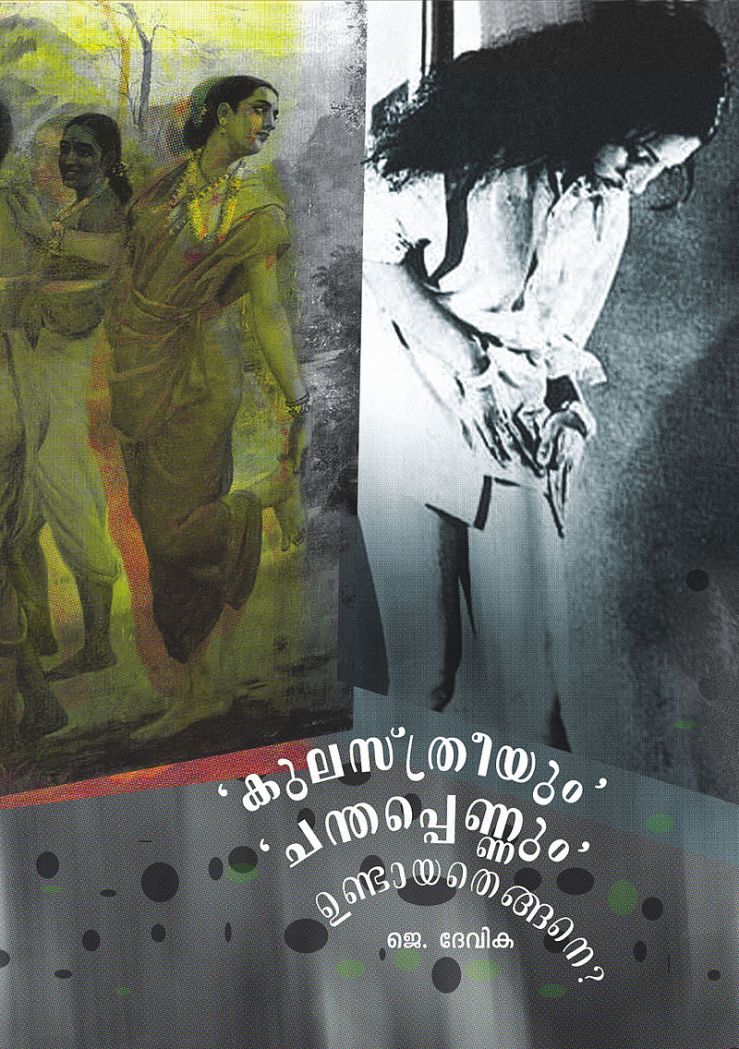
കുലസ്ത്രീയും ചന്തപ്പെണ്ണും ഉണ്ടായതെങ്ങനെ?
The Impossibility of ‘Women’s Politics’: A Clue to Why the Memory of the First-Wave Feminists in Kerala Was Erased
[This is an excerpt from a historical chapter on women and politics in 20th century Kerala from J Devika and Binitha V Thampi, New Lamps for Old? Gender Paradoxes of Political Decentralisation in Kerala, New Delhi: Zubaan)
…. From the early 20th century onwards, a clear divide is perceptible between the the Travancore government and the newly-educated male elite active in the nascent civil society on the question of women’s role in public politics. For the former, fostering women’s presence in this new domain was linked to the Travancore kingdom’s need to convince the British rulers of its ‘progressiveness’. For the latter, however, public politics was the arena for the modernising communities of Travancore to compete for resources and make demands for rights upon the state. Advancing the interests of women as a separate group was read as undermining the internal unity that communities required in these contests.1 In the discourse of the former, ‘women’ often referred to matrilineal women; in that of the latter, the same category was conceived of within the new patriarchy emergent in social and community reformism, in which secularised brahmanical patriarchy identified women with the ‘social’, rather than the ‘political’. Continue reading “The Impossibility of ‘Women’s Politics’: A Clue to Why the Memory of the First-Wave Feminists in Kerala Was Erased”
The Sweetmeat: K Saraswathi Amma
Love, as far as Woman is concerned, is a terribly alluring sweetmeat. You can intoxicate her with it and like a skilled magician, lead her anywhere; make her do anything. All you need to do is to make sure that her intelligence and discretion do not have a chance to ignite the life-force and rouse her from that emotional languor. Fear not – at no time will she free herself from that daze. Continue reading “The Sweetmeat: K Saraswathi Amma”
 Swatantryavaadini