
Many first generation Malayali feminists remained invisible because they were overshadowed by their male relatives who had easy access to public life, but K R Narayani Amma was overshadowed by her famous sister, the formidable K R Gouri Amma, the stellar communist and public figure whose presence filled the history of twentieth century politics in Kerala. Here is a short essay on her by M A Anooj, which throws light on this remarkable woman from the early twentieth century:
Continue reading “K R Narayani Amma: A Forgotten Pioneer”Category: Biography/Memory
Short pieces about first-generation feminists, well-known or little-known.
Piano Woman: Annamma Tharakan
[This is a short memory piece on Anna Tharakan (Pennamma to her loved ones) (1921-2021), who pursued her love for music from the 1920s till her passing in 2021. It is written lovingly by Reju George, as an FB post in the group Byegone Plantation Days (25 June 2024)]
Annamma/Pennamma Tharakan was born with an ear to music on Oct 15 , 1921 to a Syrian Catholic planter family in Kanjirapally.Her father K I Thomas was a First Generation Planter.
Continue reading “Piano Woman: Annamma Tharakan”Teresa Joseph Kalpurackal: Pioneer Planter
[This post is from a Facebook post by Reju George in the group Bygone Plantation days, 3 June 2024. He is her grand nephew. Teresa Joseph belongs to a generation of Syrian Christian and Nair who chose to stay unmarried at a time when dowry rates were rising and dowry as groom-price was becoming pervasive across the elite communities. They chose professional work, and other kinds of economic and public activities, as Reju’s memories reveal. Teresa’s work as a philanthropist also throws light on a very poorly researched area of women’s history in Kerala.]
Continue reading “Teresa Joseph Kalpurackal: Pioneer Planter”Excerpt from the biography of E K Janaki Ammal: S Preetha Nair
[Savithri Preetha Nair’s Chromosome Woman, Nomad Scientist — E K Janaki Ammal, A Life 1897-1984 is an extraordinary achievement. It carefully-lovingly- follows the life, times, and achievements of a woman achiever from Malabar in the early twentieth century, who was almost forgotten in Kerala till very recent times. Nair is a historian of science and independent scholar based in London. Below is an excerpt from the book — which reminds us of how women as knowledge-makers are so easily forgotten and rewarded so late. But speaking from Kerala, it might seem that Janaki was able to pursue science avidly only because she was outside Kerala — so hostile is this state to thinking women outside literature]
In 1977, when she was almost eighty, the Government of India finally decided to award Janaki a Padma the fourth-highest civilian award; a terribly belated recognition for the first Indian woman to be awarded a doctorate in the botanical sciences, the first woman to head a central government institution of science, the only Indian female presence at landmark international scientific conferences, and symposia, even up until the 1960s, and perhaps the only practising Vavilovian evolutionary biologist and plant ecologist, male or female, in the country at this time, precociously aware of the need to conserve forests and genetic resources in general. It goes on to show how little her science and its significance mattered to powers that be; that she was a woman and a nomad didn’t help either.
The belated recognition is ever more surprising given how close she was to Prime Minister Jawaharlal Nehru and V K Krishna Menon, in her capacity as a world-ranking expert on plant biology. Several male Indian botanists/agricultural scientists/geneticists, (almost all whom worked with her at sometime or the other except perhaps M S Randhawa, and most with far less research experience or international exposure) had been already honoured with a Padma…
… Speaking of the few women Padma awardees prior to 1977, these were chiefly in recognition of their contributions to ‘public affairs’, ‘civil service’, ‘literature and education’, ‘arts’, and ‘social work’; a few went to the field of medicine (nursing chiefly, but one went to a doctor), one to sports (Aarti Saha, 1960) and only two to scientists: Savitri Sahni ( Padma Shri ,1969, as science administrator rather than for a direct contribution to science), and Asima Chatterjee born 1917 (Padma Bhushan, 1975: earned her doctorate in chemistry in 1944 from the University of Calcutta). Perhaps Janaki (born 1897: earned her doctorate in 1931 from the University of Michigan) took consolation from Mary Poonnen Lukose (1886-1976) from her home state of Kerala, who was the first woman Surgeon General in India, but was awarded the Padma Shri as late as 1975, just a year before she died, at the age of ninety!
The Vibrant Life of KS Ammukkutty: Nipin Narayanan
[Sadly enough, the high-point of militant working-class struggles in Kerala, the late 60s and early 70s, remains poorly researched. This piece on a militant communist is a treasure indeed.]
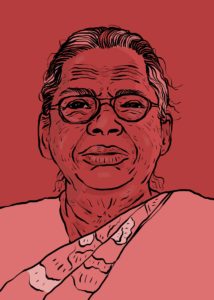
Illustration by:- Nipin Narayanan
The story of a woman-dalit agricultural worker without formal education who rose up to be a leader of the communist movement
– Nitheesh Narayanan
On 24 January 1970, a group of goons of the Indian National Congress and other groups who were part of the then right-wing government of Kerala attacked KS Ammukkutty — a 36-year-old leader of the Kerala State Agricultural Workers Union. She was on her way, along with a few other women comrades, to the place in Alakkode, Kannur district, where communist leaders had come for a discussion with the local landlord during a militant land struggle. The goons lurking in the forest grabbed her by the hair and trampled her. Beaten all over the body, she was left unconscious. Many thought she would not survive. It took almost one year of intense care and treatment for Ammukkutty to return to normal life. “I was lying unconscious for many days. I could not move from bed for months. It pained throughout the body and it took six months for me to eat even a bun,” the 86-year-old Ammukkutty recalls. The injuries it caused lasted long, perhaps for a lifetime.
Read the rest on : https://thetricontinental.org/asia/ammukkutty/
Mariyumma Mayanali Maliyekkal: A Memory
[M M Mariyumma (1925-2022) is believed to be the earliest Muslim woman to secure an English education in Malabar, but her cousins the ‘Mayin sisters of Tellicherry’ — Amina Hashim, Ayesha Rauf and Haleema Abootty probably preceded her. This article relates her life.]
Today men and women enjoy equal status guaranteed by our Constitution. But there was a period when men dominated, especially in the field of education and occupation. Yet, there were people whose thought processes were ahead of their age. Such a family was Maliyekkal, a prominent Muslim family of Thalassery, Kannur. O.V Abdulla senior, a member of Maliyekkal was a well-known Islamic scholar and a commission agent in a tea estate. As a nationalist, ignoring the words of the religious heads, he made her daughter Mariyumma study at the Sacred Hearts English Medium Convent School.
Read the rest here:
Excerpts from Ayesha Rauf: A Pioneer of Muslim Women’s Emancipation in Sri Lanka by Farzana Haniffa
[The following are a series of excerpts from the biography of Ayesha Rauf (Ayesha Mayin) (1917-1992) by Farzana Haniffa (Ayesha Rauf: A Pioneer of Muslim Women’s Emancipation in Sri Lanka, Social Scientists’ Association, Colombo, 2014) who migrated to Ceylon from Malabar through marriage in 1944. Her work in Muslim women’s education and her public life spans across Malabar and Ceylon. Haniffa remarks that despite her pioneering role, “Rauf is a personality who has been “hidden from history.” Fallen through the cracks even of Sri Lankan feminist historiography, Rauf hitherto merited a short footnote in the narratives on education, politics or the status of Sri Lankan Muslim women.” (2014: 1-2). If this is the case in SL, it is doubly true for Kerala. Ayisha Rauf’s life as narrated by Haniffa is such a marvellous illustration of what educated Malayali women were, and are, capable of, once freed from the shackles of narrow family and regional identification. It is worth noting that the same trajectory seemed completely unavailable to her peers in Kerala who had attained the same levels of education and work experience — neither her Muslim nor non-Muslim peers…
Continue reading “Excerpts from Ayesha Rauf: A Pioneer of Muslim Women’s Emancipation in Sri Lanka by Farzana Haniffa”The Serving Women of a North Malabar Brahmin Illam
[This excerpt is from a book written by Madhavan Purachery about the memories of his father and mother, members of the Malayala brahmin community who were witnesses to and participants in the tumultous social change in northern Malabar in the early 20th century, titled Ammayute Ormappustakam (Mother’s Book of Memories) (Mathrubhumi Books, Kozhikode, 2022). The recollections included in this book are also of little-known and little-discussed presences in the Malayala brahmin homes. Malayala Brahmins or the Nambudiris as they are known now, were the most powerful groups in early 20th century Kerala, occupying the apex of the caste order and owning large properties, but the plight of the women in these groups was extraordinarily bleak. Malayala brahmin were subject to very strict restrictions and were expected to remain unseen by anyone other than immediate relatives and any breach of this, punished by the harshest penalties. The undervaluing of women was rampant and any straying from strict submission could result in ejection from the caste community through a total severance of kin ties and social death.
Continue reading “The Serving Women of a North Malabar Brahmin Illam”Memories of Interdining: Kochattil Kalyanikkutty Amma
[The famous events of interdining organized by the eminent anti-caste reformer from Kochi, Sahodaran K Ayappan caused paroxysms of rage to lash the caste-elite dominated town of Thrissur from 1917. Kochattil Kalyanikkutty Amma, who participated in one such event in the mid-1920s, gives a first-person account of it, and the consequences she had to face afterwards, in her autobiography Pathikayum Vazhiyorathe Manideepangalum. Below is a translation.]
Continue reading “Memories of Interdining: Kochattil Kalyanikkutty Amma”College Days: Kochattil Kalyanikkutty Amma
[Kochattil Kalyanikkutty Amma (1907-1997) (she used her married name in public, Mrs C Kuttan Nair), though little-known in Kerala today, was one of the most vocal, bold, and well-read feminists of the first generation in Kerala. She paid an enormous price for her unbowed attitude, but her life was so much richer for the expansion of the mind she gained through travels all over India and in Europe as well as her deep interest in the most exciting debates of her times, including contraception, women’s rights, and nationalism. I have translated some of her articles which may be read here, but below is an excerpt from her autobiography Pathikayum Vazhiyorathe Manideepangalum (Wayfarer-Woman and the Wayside Lamps). She studied in Queen Mary’s College, Madras in the early 1920s and remembered vividly the many great women and men she heard and met in the city which shaped her deeply cosmopolitan outlook.
Continue reading “College Days: Kochattil Kalyanikkutty Amma” Swatantryavaadini